Investor guide · yachts
Is yacht charter profitable: the sourced answer is net 2–8% a year.
Is yacht charter profitable is a question with a sourced answer: owner-side publications put the net yield at 2–8% of the yacht's value a year, often 2–4%, after running costs of 10–15% of value and an agent's 15–20% of every fee. Most owners charter to shrink the bill, not to earn. This guide sets out the ranges, shows how narrowly they reconcile, and ends with the part of a charter that bills by the hour: the toys.
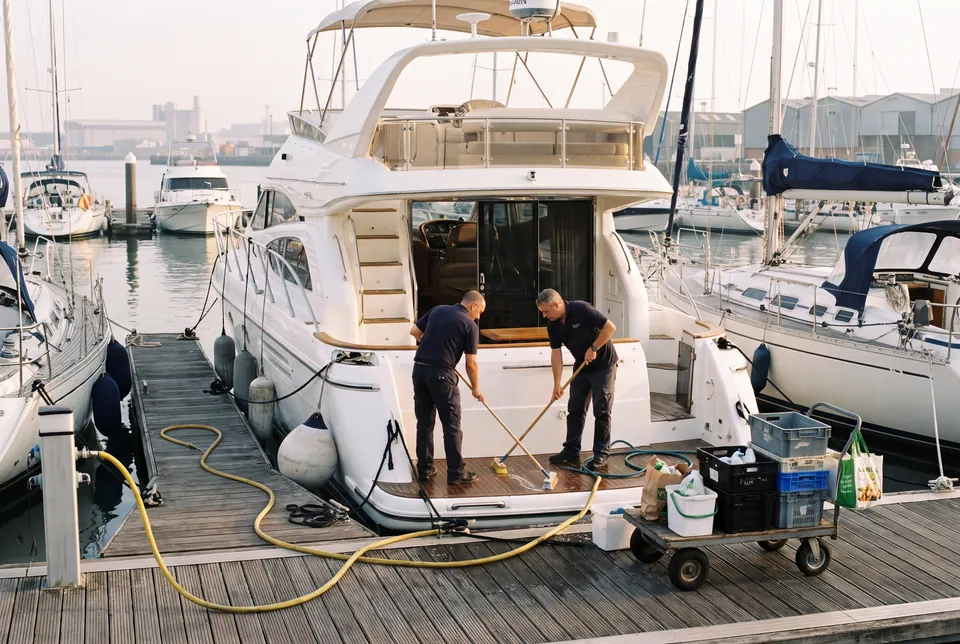
Is yacht charter profitable on paper: four published ranges.
Three publications that write for yacht owners give broadly the same picture (The Luxury Playbook, BOAT International, Practical Sailor).
- Gross charter income: 8–15% of the yacht's value per year.
- Running costs: 10–15% of the purchase value per year, chartered or not.
- Agent or management: 15–20% of each charter fee.
- Net yield: 2–8% of value, and often 2–4%.
Read the first two lines together. Income of 8–15% against costs of 10–15% means that across much of the range the costs are larger than the income. A yacht that charters well covers a large part of its own bill. A yacht that charters badly still costs 10–15% a year. Purchase prices run from six to eight figures, so every percentage point is a large sum.
Yacht charter yields and costs, as published.
| Line | Published range | On a USD 1 million yacht |
|---|---|---|
| Gross charter income per year | 8–15% of value | USD 80,000–150,000 |
| Agent or management fee | 15–20% of the charter fee | USD 12,000–30,000 |
| Running costs per year | 10–15% of purchase value | USD 100,000–150,000 |
| Net yield quoted by the sources | 2–8% of value, often 2–4% | USD 20,000–80,000; often USD 20,000–40,000 |
| ‘Guaranteed’ income programmes | 8–9% paid to the owner | USD 80,000–90,000, read as a subsidy from the seller |
Sources: The Luxury Playbook; BOAT International; Practical Sailor. The percentages are theirs. The USD column is our arithmetic on a round USD 1 million, chosen for illustration; it is not a market price.
Worked example: where the published ranges meet.
Take the best corner of the table. Gross income at 15% is USD 150,000. The agent takes 15–20%, or USD 22,500–30,000. Running costs at the low end are USD 100,000. What is left is USD 20,000–27,500, a net yield of 2.0–2.75%. That matches the ‘often 2–4%’ in the sources.
Now the middle. Income at 11.5% is USD 115,000. The agent's 17.5% is about USD 20,000. Running costs at 12.5% are USD 125,000. The year ends about USD 30,000 below zero. At the weak corner, 8% income against 15% costs, the gap is USD 82,000–86,000.
So the upper end of the published net range, 8%, cannot come from these figures on one yacht. It needs income above 15% or costs below 10%. The three publications do not share one cost base, and we treat their ranges as separate estimates. This is our own arithmetic on published percentages, for illustration only. The practical reading: yacht investment returns after costs sit in low single digits in a good year and below zero in an ordinary one.
Yacht charter business profit margin: owner and operator are different businesses.
Searches for yacht charter business profit margin mix two businesses. The owner holds the capital and pays the running costs. The charter company or agent sells the weeks and takes 15–20% of the fee without owning the hull. One earns on capital, the other on turnover.
For the company side our research found no reliable public data on margins, fleet sizes or overheads, so we print none. The structure still tells you something: the party without the yacht has no 10–15% running bill. Anyone who wants to invest in yacht charter should decide first which of the two businesses they are entering.
New charter markets do open. The Saudi Red Sea Authority had issued nine yacht-charter licences by the second quarter of 2026, with marinas licensed in Jeddah, Yanbu, Jazan and Al-Lith (Cyprus Shipping News). The Saudi Arabia page covers the licensing side.
Guaranteed-income programmes: read them as a discount.
Charter ownership programmes advertise a ‘guaranteed’ payment to the owner, quoted at 8–9% a year. Set that beside the ranges above. A yacht that nets 2–4% in the open market cannot fund 8–9% from charter alone.
The owner-side sources read the difference as a subsidy: in effect, part of the purchase price coming back in instalments. It can still be a fair deal, as a discount. It is not evidence that chartering earns 8–9%. Ask what the yacht will be worth when the programme ends, who pays for the refit, and what happens if the operator closes.
Why owners charter anyway.
The reason is on the cost side. A yacht costs 10–15% of its value a year whether it leaves the berth or not. An owner who would keep the yacht anyway treats every charter week as a reduction of that bill. Covering half the running costs is a good result by that standard.
There are softer reasons too: a crew that works stays in practice, and systems that run get maintained. These are owners' arguments, not figures we can source. Tax and flag effects differ by country and sit outside our research; take them to a specialist.
So is owning a yacht for charter profitable: as an investment, on the published numbers, rarely. As a way to own a yacht for less, it can work.
Chartering your yacht: what it gives and what it costs.
What it gives
- Income of 8–15% of value a year against the running bill, on published ranges.
- A crew and systems kept in regular use.
- A managed booking channel through an agent.
What it costs
- 15–20% of every fee to the agent or manager.
- Running costs of 10–15% of value a year that continue without bookings.
- Wear, and weeks when the yacht is not available to you.
- A net of 2–4% in the better published cases, and a loss in an ordinary year on our arithmetic.
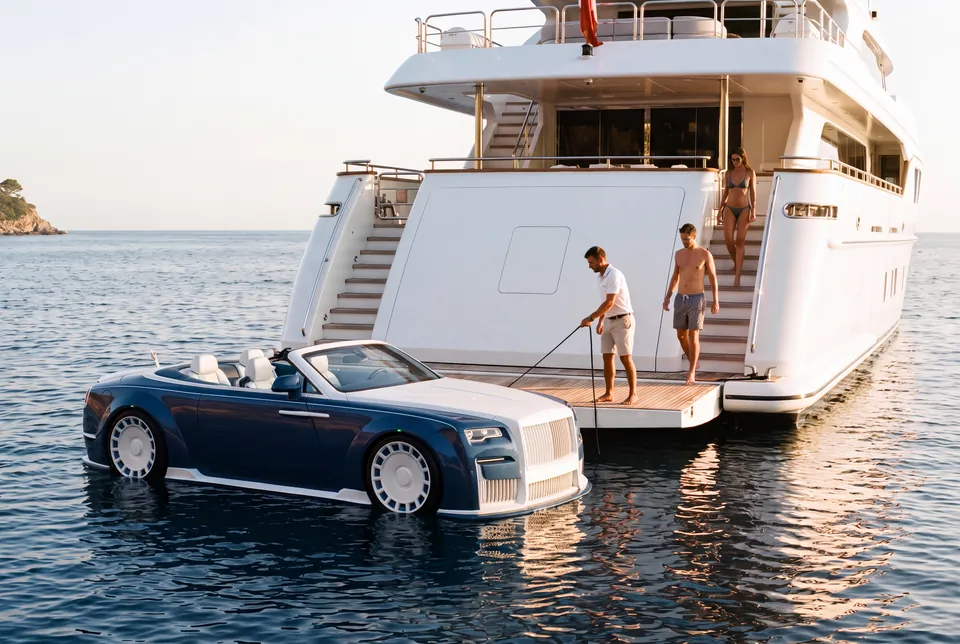
The part that bills by the hour: toys.
A charter fee is fixed for the week. Toys are sold on top, by the hour or the slot, and they are where a small amount of capital meets a high ticket. In Miami one operator lists a jet car at USD 350 an hour from its own dock and USD 400 an hour plus USD 150 when it is delivered to a yacht (operator price page, November 2026). In Dubai, yacht companies appear among the jet car operators we found, with rides listed at AED 750–1,200 (about USD 204–327) for 30 minutes. Maldives resorts publish USD 499–599 plus taxes per hour.
A jet car is a jet boat with a convertible-style body and 4 seats. We sell the R series, built in the United Arab Emirates, at USD 24,490, USD 26,990 or USD 28,990 for the craft without engine and about USD 50,000 complete, per the builder's catalogue (price page). For scale, a single-rider Seabob costs USD 9,980–17,780 at a US retailer; more in luxury water toys.
The fit with a charter business is practical: the company already has crew, a berth and guests on board. What it may not have is a rental permit for a second craft. Check that first; the yacht charter page and the Florida page go into it.
One jet car as a charter add-on: illustrative numbers.
Our scenario for a craft added to an existing Dubai operation where crew, berth and permit are already paid. Illustrative, not a forecast.
| Line | Weak case | Base case |
|---|---|---|
| Realised price per booked hour | USD 270 | USD 380 |
| Booked hours per operating day | 1.0 | 1.75 |
| Operating days | 250 | 280 |
| Revenue per year | USD 67,500 | USD 186,200 |
| Operating costs per year | USD 42,500 | USD 75,360 |
| Operating result before depreciation | USD 25,000 | USD 110,840 |
| Outlay | USD 53,000 | USD 53,000 |
| Payback | about 25 months | about 6 months |
Our own illustrative scenarios, from rental prices listed publicly in November 2026 and our cost assumptions. Before tax and before depreciation, which we assume at 22% of craft cost a year. A stand-alone craft without shared crew and berth loses money in the weak case.
What the add-on numbers do and do not show.
Set the two assets side by side with care. On published ranges a USD 1 million yacht nets USD 20,000–40,000 in a good year. In our weak add-on case one jet car leaves USD 25,000 before depreciation on an outlay of USD 53,000. Per dollar, the toy earns far more than the yacht. That is the whole argument, and it has conditions.
The craft is an operating business, not passive income. It needs a guide, an escort jet ski on most rides, fuel, maintenance and bookings. Stand-alone, the costs are USD 75,000–180,000 a year on our estimate, the base-case payback is 11–20 months, and in the weak case the craft never pays back. Break-even is about one sold hour per operating day. Used craft list far below new ones: AED 60,000 for one in Abu Dhabi (OpenSooq).
The catalogue figure of USD 500–700 an hour holds only as a list price for 20–30-minute slots in a few places; Miami's realised range is USD 175–350 per booked hour. Put your own figures into the ROI calculator, read the rental business page, and send us your yacht's base and guest numbers on WhatsApp.
Questions buyers ask on WhatsApp
Is owning a yacht for charter profitable?
Rarely as an investment. Published ranges put net yield at 2–8% of value and often 2–4%, and our arithmetic on those ranges shows a loss in an ordinary year. Owners charter to reduce running costs of 10–15% a year. Other assets are compared in rental business ideas.
What is a typical yacht charter business profit margin?
For owners the published net is 2–8% of the yacht's value. For charter companies and agents, who take 15–20% of each fee, our research found no reliable public margin data. The cost lines that eat rental margins are explained in best assets to rent out.
Are guaranteed yacht charter income programmes real?
They pay, typically 8–9% a year, but owner-side sources read that as a subsidy built into the purchase price, not as charter profit. Ask about resale value and refit costs at the end. The same caution applies to supercar programmes: see the supercar rental guide.
How can I invest in yacht charter with less capital?
One route is to own a toy instead of the yacht: a craft that an existing charter company bills by the hour. A complete jet car costs about USD 50,000 per the builder's catalogue. The yacht charter page explains the arrangement.
What are realistic yacht investment returns after costs?
Low single digits in a good year: 2–4% is the figure the sources repeat. In a weak year the running costs exceed the income. If you want an asset that needs no work from you, read how to invest 50k for passive income.
How much does a jet car rent for next to a yacht?
One Miami operator lists USD 400 an hour plus USD 150 when the craft is delivered to a yacht, and USD 350 an hour at its dock. Maldives resorts list USD 499–599 plus taxes per hour. Prices by country are on the market pages.
Read next
Yacht charter
Jet car for yacht charter: Miami operators deliver one to the yacht at about USD 400 an hour. Storage, crew, trims and who should not buy. Ask on WhatsApp.
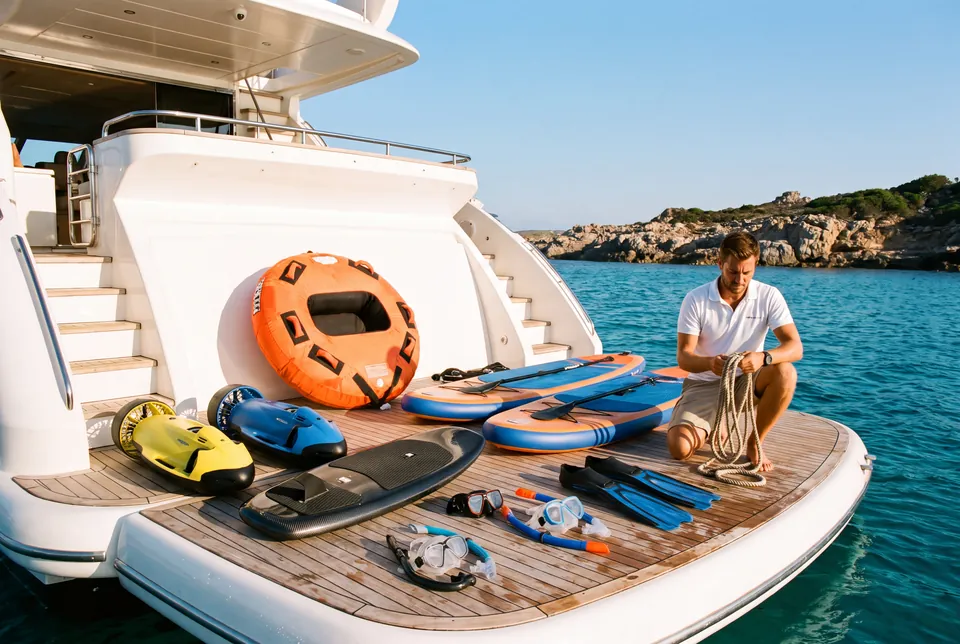
Luxury water toys
Luxury water toys with published prices: Seabob from USD 9,980, jet car from USD 24,490, amphibious car from USD 135,000. Seats, storage, crew. WhatsApp.

Supercar rental business
Supercar rental business numbers: AED 2,500–6,500 a day in Dubai, a 16–20% vendor claim, and a jet car at about USD 50,000. Ask us on WhatsApp.