Import guide, November 2026
How to import a jet car: duty, tax, certification and shipping.
To import a jet car you pay customs duty and VAT on a craft usually filed under HS heading 8903, register it as a boat, and in the USA and the EU show that the engine and hull meet local rules. Duty runs from 0% in the UK and on Langkawi to a reported 35% in Thailand, and freight from the UAE has been unusually volatile in 2026. This guide lists the figures we found, their sources and how far to trust each one.

What customs call a jet car
Customs authorities file small motor boats under HS heading 8903, the heading for yachts and other vessels for pleasure or sport. In the tariff schedule we checked, an inboard craft shorter than 7.5 m sits in subheading 8903.31 and an outboard version in 8903.93. National schedules add their own digits and the subheading can differ, so give your customs broker the builder's specification sheet and let them confirm the code before you order. Treat our subheadings as a starting point, not as a ruling.
The body is car-shaped, but the craft is a boat: a planing hull, a jet drive, no road wheels. Describe it as a jet boat on the invoice and in the broker's instructions, and attach photographs of the hull and the stern jet nozzle. The class as a whole is 4.5–5.4 m long and about 2.0 m wide, per published guides to the class. The builder does not publish length, beam, weight or engine output for the R series, so we send them with the written quote. The craft costs USD 24,490–28,990 without engine, and the engine is quoted separately; see the price page for the trims.
Who pays? The buyer. Import duties, taxes, registration and operating licences differ by country and are the buyer's responsibility. Our job is to give your broker complete, consistent paperwork so the entry is not held up at the port.
Duty and tax by market, and how far to trust each figure
The table below collects the figures we found in November 2026. The last column says how reliable each row is. Where it says aggregator, the figure comes from a tariff comparison website and has not been checked against the national tariff.
| Market | Import duty | VAT and other taxes | Rules to check | Reliability |
|---|---|---|---|---|
| UAE | None, domestic sale | VAT 5% | Registration with the emirate's maritime authority. Dubai also requires a marine craft licence for the driver and a permit for rental. | Reported by Khaleej Times and the Dubai maritime regulation |
| Saudi Arabia | GCC common tariff 5% on most goods, 0% with a GCC certificate of origin | VAT 15% | Red Sea coast: operator licence plus a rental licence for each boat, technical inspection, rental only through licensed marinas. | Line-level rate for HS 8903 not confirmed |
| Qatar, Kuwait | 5% common tariff, 0% with GCC origin | No VAT | Registration with the coast guard or ministry. | Unverified at line level |
| Bahrain, Oman | 5% common tariff, 0% with GCC origin | VAT 10% in Bahrain, 5% in Oman | Local marine registration. | Unverified at line level |
| USA | 1.5% (HTS 8903.31.00) plus any surcharge in force | State sales tax | EPA-certified engine, Coast Guard hull identification, state registration. | Surcharge status after July 2026 unknown |
| EU (Spain, Greece, Cyprus, Malta) | About 1.7% | VAT 19–25% | CE marking is mandatory. | Typical figure |
| United Kingdom | 0% | VAT 20% | UK conformity marking under recreational craft rules. | Aggregator |
| Malaysia | 0% (Langkawi is a duty-free island) | Sales and service tax 0% | Marine Department registration. | Aggregator |
| Thailand | 35% | VAT 7%, possible excise | Marine Department registration, caps on rental craft in Phuket. | Aggregator; conflicts with other information, verify with Thai Customs |
| Indonesia | 5% | VAT 12%, import income-tax prepayment 2.5–10%, luxury tax of 75% on yachts unless used for a tourism business | Import licensing, vessel registration, a foreign-owned company for foreigners. | Whether a jet car counts as a yacht is unconfirmed |
| Australia | 5% | GST 10% | State licence for personal watercraft; commercial hire rules. | Aggregator |
| Philippines, Vietnam, India, Brazil | 7–10%, 15% (10% preferential), 20%, 18% | VAT 12%; special consumption tax 30% plus VAT 8–10%; IGST 18–40%; IPI 6.5–10% | Not researched. | Aggregator |
Sources: tariff comparison site treayo.com (HS 890331), GHY trade guide on importing a boat into the USA, Khaleej Times, Arab News, Clyde & Co (Saudi licensing, January 2026), Danish Maritime Authority (CE marking), DDTC (Indonesian yacht luxury tax), collected 12 November 2026. For the Maldives, Jamaica, Turks and Caicos, Mexico, Egypt and Turkey we found no duty figure at all, and the Bahamas figures conflict. Verify every figure with a customs broker.
Certification stops more shipments than duty does
In the USA a jet car needs an engine certified by the Environmental Protection Agency, shown by an emission label on the engine, a hull identification number issued under US Coast Guard rules from a builder that complies with them, and a state registration. Florida also requires a boater safety card for anyone born after 1 January 1988; check the rule in your own state. If you plan to operate in Miami or the Keys, read the Florida page first: it explains why Florida is the hardest paperwork market for an imported craft.
In the EU, CE marking under the Recreational Craft Directive 2013/53/EU is mandatory for a boat placed on the market. If a craft arrives without it, the importer carries the obligation to have it assessed after construction by a notified body, according to Danish Maritime Authority guidance. We found no price for that assessment, so treat it as an open cost. The Greece and Cyprus page and the Spain page cover what this means for island operators. The United Kingdom has its own marking under its recreational craft rules; we did not research the detail.
We do not claim CE, EPA or Coast Guard status for the R series. The builder's published material does not state it. Ask us for the certificate status of the engine and hull in writing with the quote, and ask your broker which proof your port will want. In the Gulf the practical gate is different: registration with the maritime authority and, for rental, an operator licence. See Dubai and Saudi Arabia.
The paperwork that travels with the craft
A typical import file for a boat has the same core documents everywhere: a commercial invoice that describes the craft as a jet boat with its trim, colour and engine, a packing list, a bill of lading for sea freight or a road consignment note for trucks, the specification sheet, the hull and engine serial numbers, and insurance for the voyage. We supply the export documents and the builder's specification sheet. Your broker files the import entry and handles registration.
A certificate of origin deserves a separate question. If the craft qualifies as GCC national origin, imports into the other GCC states are duty-free; if the factory sits in a free zone, expect the 5% common tariff. We do not assume either: we confirm the origin status with the builder and put it on the quote. Plan your landed-cost estimate on the higher figure until we do.
Importers who plan to rent the craft out need a second file: the operator permit and, in some places, a licence for each boat. In Saudi Arabia on the Red Sea coast that means a Saudi Red Sea Authority operator licence plus a rental licence per boat, with rental only through licensed marinas. Start those applications at the same time as the order. Business owners comparing markets can read business ideas in Saudi Arabia and the rental business page.
Road to the Gulf, container to everywhere else
Within the Gulf the craft travels on a truck. Dubai to Riyadh via the Al Batha crossing takes about two days express and three to five days on standard service, so plan 2–5 days by road. Freight vendors quote AED 3,200–9,000 for a full truck on the Riyadh lane and AED 6,000–22,000 for a dedicated truck, and land-bridge rates were reported up four to five times in April 2026 (FreightAmigo and press reports). Our estimate for budgeting is USD 1,500–4,000 per truck carrying one or two craft to Riyadh or Dammam, and more to Jeddah.
Outside the Gulf the craft goes in a container, shrink-wrapped on a steel cradle with timber blocks and ratchet straps. Our estimate, to be confirmed with the real dimensions: a standard 20-foot container is about 5.90 m long inside with a 2.34 m door, so one craft up to about 5.6 m by 2.0 m fits on a cradle. A 40-foot container takes two craft end to end, and four only if the height on the cradle allows double stacking in a high-cube container of 2.69 m inside height. The class is 4.5–5.4 m long and about 2.0 m wide, so most R series craft should fit one to a 20-foot container, but we state it only after we have the builder's numbers. See the delivery page for how a shipment is handled.
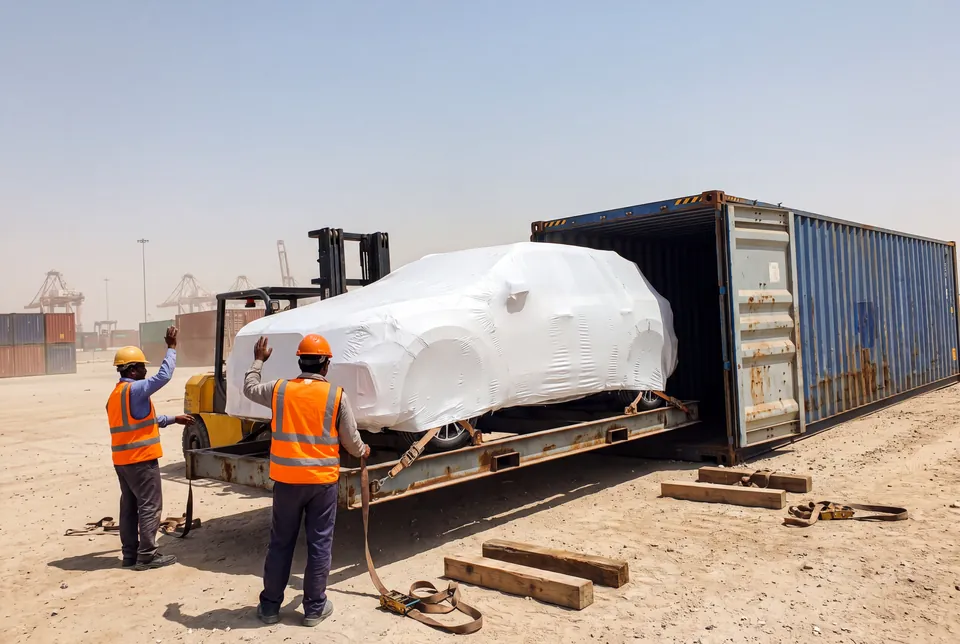
What shipping costs in late 2026, and why we quote every shipment
Sea freight from the UAE is unusually hard to price this year. A conflict that began in late February 2026 closed the Strait of Hormuz from March, with a partial and uneven reopening from June, and a container ship was reported sunk in the strait in mid-October. Dubai Customs Notice 03/2026 allows bonded trucking between Jebel Ali and the east-coast ports of Khor Fakkan and Fujairah, which lie outside the strait, but those ports are congested and vessel delays of more than ten days were reported. We found no published export quote from the UAE to Asia or the USA, so the table below shows how far rates on nearby lanes moved.
| Benchmark | Normal level | 2026 level | Source |
|---|---|---|---|
| India to Jebel Ali, 40-foot container, average | USD 734 (2025) | USD 6,216 (April 2026) | S&P Global |
| China to Jebel Ali, 40-foot container | USD 1,950–2,550 (Q1 2026) | USD 7,300–9,360 (July–September 2026) | Goodhope Freight |
| Jebel Ali container throughput, first half-year | 7.77 million TEU (2025) | 3.14 million TEU (2026) | Marine Insight |
| Carrier transit fee for the strait | None | USD 1,000 per container (August 2026) | Maersk operational update 43 |
Sources as listed, collected 12 November 2026. These are lane benchmarks, not quotes for a jet car.
For planning only, our estimate for a normal year is USD 600–1,500 for a 40-foot container from Jebel Ali to South-East Asia and USD 2,500–4,500 to the US East Coast. For the rest of 2026, budget USD 3,000–9,000 per container plus the trucking leg to an east-coast port, and treat the sea leg as a quote that expires. That is why we price delivery per shipment and never print a fixed freight rate. Send us the destination port and we will return a delivered figure with an expiry date.
Before you order: seven questions for your broker
- Which HS subheading does your customs use for an inboard or outboard jet boat under 7.5 m, and what is the duty on it?
- What VAT or sales tax applies, and is it recoverable if you rent the craft out?
- Does the port require engine or hull certification, and what proof does it accept?
- Can the craft be registered as a boat in your name or your company's name, and how long does registration take?
- Does a GCC certificate of origin or any other preference reduce the duty?
- Which port will you receive it at, and does that port have a crane or a slipway for a craft of this size?
- Which operator permit do you need to rent it out, and how long does it take?
Questions buyers ask on WhatsApp
How much is import duty on a jet car?
It depends on the country. In the figures we found it runs from 0% in the UK and on Langkawi, through about 1.5% in the USA, 5% in the GCC, Indonesia and Australia and about 1.7% in the EU, to a reported 35% in Thailand. Most are aggregator figures, so verify them with a broker. See the delivery page for how we ship.
Which HS code applies to a jet car?
Small motor boats fall under HS heading 8903. In the schedule we checked, an inboard craft shorter than 7.5 m is 8903.31 and an outboard version 8903.93, but your national schedule decides the subheading. Ask your customs broker to confirm it before you order.
Do I need a certificate to import a jet car to the USA or the EU?
Yes. The USA expects an EPA-certified engine, a Coast Guard hull identification number and state registration. The EU requires CE marking, and an importer of a non-CE craft carries the obligation to have it assessed. Ask us for the certificate status with the quote; read the Florida page and the Greece and Cyprus page.
Can you ship a jet car to my country?
We deliver worldwide, by truck inside the Gulf and by container elsewhere. Whether you can import and register it is a separate question, which is why this page exists. Message us the destination port and your use, private or rental, through the contact page.
How long does delivery take?
We give a lead time with the written quote, not before. Inside the Gulf allow 2–5 days by road for the road leg. Sea transit in 2026 is hard to predict because of the strait closure and port congestion, so we quote each shipment.
Who pays the duty and taxes?
The buyer. Import duties, taxes, registration and operating licences are the buyer's responsibility. The price page lists the craft price without engine; freight and taxes come on top, and the ROI calculator uses landed costs for five markets.
Read next
Delivery
Jet car delivery worldwide from the UAE: 2–5 days by road to Riyadh, a 20' or 40' container to other ports, duty by market. Freight quote on WhatsApp.

Price
Jet car price list: USD 24,490–28,990 for the craft without engine, about USD 50,000 complete. What freight, duty and VAT add. Written quote on WhatsApp.

Dubai
Jet car for sale in Dubai from USD 24,490, built in the UAE with no import step. Ride prices, DMA permit rules and a plain market view. Quote on WhatsApp.